Start using risk-based TMF QC in practice, not just in your SOP
Turn your TMF SOP into a working QC system
This Excel template translates regulatory expectations into a structured, document-level QC framework that you can apply immediately.
It gives you a practical way to:
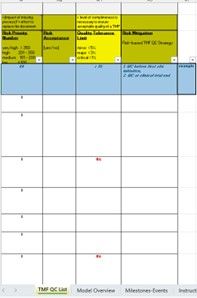
- classify document criticality
- assess risk consistently
- define QC focus areas
- document risk acceptance decisions
- demonstrate a justified, risk-based approach during inspections
The Trial Master File (TMF) demonstrates compliance, data integrity, and inspection readiness in every clinical trial.
Most sponsors already have a TMF SOP that requires a risk-based approach.
The problem is not understanding the principle. The problem is execution.
- What does “risk-based QC” actually mean at document level?
- How do you define criticality consistently?
- How do you decide which risks are acceptable and which are not?
- How do you document this in a way that stands up to inspections.
What makes this template useful
This is not a generic checklist.
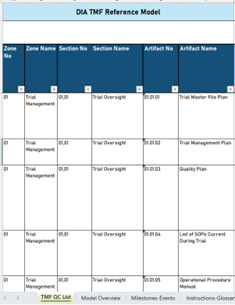
It is a structured framework aligned with the DIA TMF Reference Model v3.3 that allows you to operationalise risk-based QC across your TMF.
-
User Group
Professionals
Involved in TMF Quality Control
-
-
Content
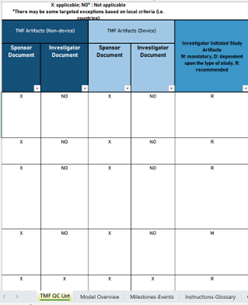
- Based on the DIA TMF Reference Model v3.3
- Pre-defined structure for artifact-level assessment
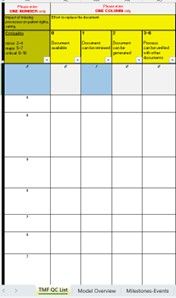
- Criticality scoring per document
- Risk scoring logic with automatic calculation
- Risk acceptance decision per artifact
- Definition of quality tolerance limits
- Structured documentation of risk mitigation
-
Benefits
- Documentation for your risk-based TMF Quality Control Plan
- Documentation for your risk-based TMF Quality Control Process
Designed for teams that already have a TMF SOP
This template is not meant to replace your SOP.
It is designed to implement it.
Use it to:
- standardise QC decisions across teams and vendors
- ensure consistent interpretation of “critical” vs “non-critical”
- create traceability of QC decisions
- make your risk-based approach audit-ready
What you gain immediately
With this template, you will:
- Apply a consistent and defensible risk-based QC approach across your TMF
- Identify gaps and issues early based on defined risk criteria
- Focus QC effort on documents that matter for patient safety and data integrity
- Reduce unnecessary full TMF reviews and rework
- Strengthen inspection readiness with documented decision logic
- Increase transparency and accountability across sponsor, CRO and sites
Why this matters
A risk-based TMF QC approach is expected by regulators.
However, many organisations cannot demonstrate how risk decisions are actually made and applied.
This template gives you:
- a clear structure
- a repeatable method
- documented justification
All in one place.